US system will prevent Ukraine from being sacrificed, as cost can be too high for whole world, expert Jejelava

Author
Frontnews Georgia
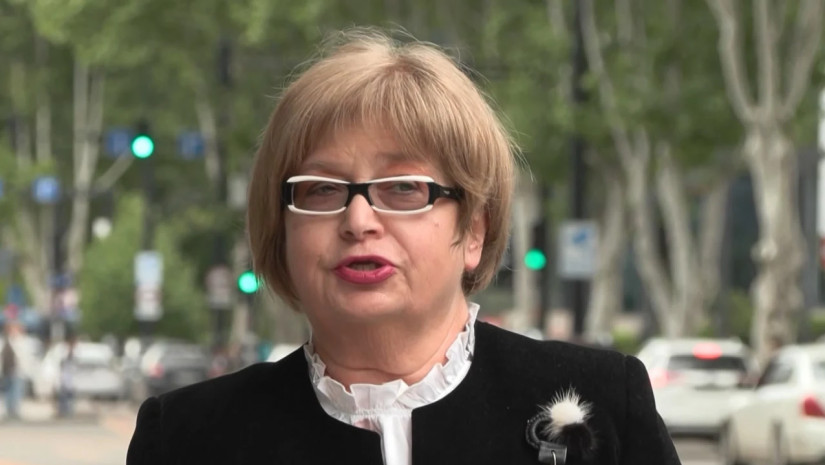
In an interview with Front News, international relations expert Lela Jejelava evaluates the peace initiatives of US President Donald Trump and the prospects for ending the war in Ukraine.
Jejelava views sceptically the possibility of ending the war “within one month” and considers Trump’s statements to be more part of his personal public relations strategy and an attempt to create “strategic ambiguity” than a reflection of established US state policy.
She stresses that any deal that bypasses the will of the Ukrainian people and the interests of Europe is doomed to fail. In her view, the final resolution of the Ukraine issue is closely intertwined with broader global challenges, including the Iran factor and attempts to distance Russia from China.
Trump has said in a conversation with Zelenskyy that he wants the war to end within a month. How realistic is such a short timeframe? Does it suggest Washington may be prepared to push Ukraine into painful compromises simply to achieve a rapid result?
We know that Donald Trump initially claimed he could end the war in Ukraine within a week. He also said he could finish it within 24 hours. The point is that Donald Trump’s statements do not constitute official US state policy, and therefore we cannot treat them as such. These statements are part of Trump’s personal public relations agenda, and I believe that both domestically and internationally they are viewed in that light.
Unfortunately, such statements give Russia an opportunity to present itself more favourably and to display assertiveness within the emerging geopolitical architecture. We have also seen remarks by Sergei Lavrov, who says Moscow is not setting any deadlines and has its own objectives.
Trump likes this kind of positioning. I understand that he is the president of one of the most powerful states in the world and is seeking to project both his own strength and that of his country. However, I do not believe it is possible to end the war within a month. We see that Europe has somewhat different interests.
Of course, Ukraine also has its own objectives that must be addressed. Despite the many challenges it faces, we can say with certainty that Ukraine remains capable of fighting. Even with the human resources currently available to it on the battlefield, Ukraine is able to continue the war.
Marco Rubio has said that the US is the only country capable of bringing the sides to the negotiating table. Does the effective distancing of European countries and the United Nations from the process risk turning any agreement into a deal between two major powers at the expense of Ukraine’s interests?
Donald Trump is a master of deals. He likes deals and considers them important. For him, the cost of such deals is less significant than the outcome itself. Above all, Trump wants to record the end of the war as an achievement to his credit. As you know, he frequently emphasises that he has ‘ended eight wars’.
In addition, if we look at the outcomes of meetings between Putin and Trump, there are specific interests at play. For Russia, negotiating face to face with the United States while sidelining Europe is already a form of political success - one that Moscow will defend vigorously. It must be said that Volodymyr Zelenskyy has navigated this situation quite skilfully. Given the current political circumstances, he has managed to adapt. However, Europe also has its own interests regarding Ukraine. This is a war taking place on European territory, and excluding Europe from the process is not appropriate. Unfortunately, we must also acknowledge that Europe allowed the situation to reach a point where it is no longer at the negotiating table. Every mistake carries a price, and that price is particularly high in a crisis such as the one we are facing.
Trump has promised Ukraine ‘significant security guarantees’. In your assessment, what could serve as an alternative to NATO membership that would genuinely protect Ukraine from further aggression, rather than becoming another ‘Budapest Memorandum’-type document?
It is worth noting that when the United Kingdom and France raised the issue of transferring nuclear weapons to Ukraine, this was a very serious signal - both to Russia and to the United States. If there is political will, Europeans are not so weak that they cannot resist an unjust decision regarding Ukraine. The most important point is that if Ukraine’s security is not guaranteed, this indirectly means that Europe’s security will not be guaranteed either.
So far, there has been no open discussion from the American side about what specific levers would be used to protect Ukraine. The most interesting aspect is that after four years, Russia is demanding the surrender of territories it has been unable to capture during that time. This clearly demonstrates Russia’s current military and economic potential. Frankly, I struggle to understand why the US is not attempting to use this to its advantage.
However, the United States has other objectives. Its interests extend further and are linked to China. Trump’s goal is to detach Russia from China as a proxy force. This is understandable, but it is not equivalent to the potential consequences of an incorrect agreement on Ukraine.
Dmitry Peskov has questioned the value of meeting with Zelenskyy. Is this a negotiating tactic by Moscow aimed at extracting further concessions from Trump, such as sanctions relief, in exchange for coming to the table?
Russia is highly focused in the negotiation process. Despite its rigidity, Russian diplomacy is goal-oriented. In many cases, it manages to obtain more in negotiations than it objectively deserves. Nevertheless, I believe the system in the United States will ensure that the American position in these talks is not disadvantageous. Ukraine will not be sacrificed, because representatives of the system understand that such a move could prove extremely costly - not only for the United States, but for the entire world. Moreover, ending this war within one month is simply not feasible.
Economic recovery mechanisms are being actively discussed in Geneva. Does this reflect Trump’s business-style approach - ‘economic assistance in exchange for territories’? How acceptable would such a formula be to Ukrainian society?
I believe Trump’s position - that Ukraine’s fate could be decided between the United States and Russia in a way that does not correspond to the will of the Ukrainian people - is wrong, and it cannot happen that way. Without the will of the Ukrainian people, Zelenskyy cannot take any step. I do not think Ukrainians are willing to surrender territories not currently occupied by Russia without a fight. No Ukrainian would want to present these territories to Putin on a silver platter.
If a trilateral meeting planned for early March moves towards a concessions-based agreement, how might this affect Zelenskyy’s approval ratings and internal stability? Could it trigger a domestic political crisis?
Neutralising Zelenskyy as a political figure would have no impact on the will of the Ukrainian people. If anyone expects that, it is a mistaken expectation. Whoever stands in Zelenskyy’s place would be unable to take a decision that contradicts Ukraine’s national interests. Clearly, this is not an easy situation; it is extremely complex.
In addition, the United States faces a very complicated issue in the form of Iran, and no one knows how events there will unfold. Trump has set the bar quite high regarding Iran, and this matter must now be addressed. Therefore, his statements - which often create strategic ambiguity in the Middle East, in Gaza, in relation to Iran or Ukraine - do not always coincide with official US state positions. At times, one could say that such strategic ambiguity even benefits the United States.
“I do not expect a final resolution of the Ukraine issue before the Iran question is addressed. How Iran reshapes the regional situation is a separate matter. Accordingly, I do not anticipate any major breakthrough on Ukraine in the near term. Perhaps some clarity will emerge by the end of the year, but until then I do not expect a turning point in the war.”
By Elza Paposhvili
Tags:
Lela Jejelava