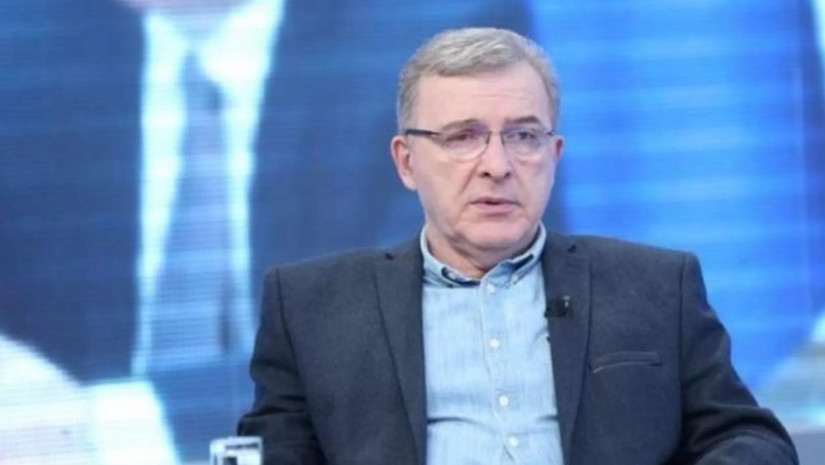
Georgia can’t enter political talks with Russia unless Moscow takes real steps on territorial integrity, Mamuka Areshidze

Author
Frontnews Georgia
Political tensions surrounding transport corridors in the South Caucasus are once again rising. On February 15, Russian Deputy Prime Minister Alexey Overchuk reaffirmed that Moscow is actively considering the restoration of the railway through occupied Abkhazia - a project viewed by the Kremlin as a strategic instrument to reduce dependence on Azerbaijan and to reassert influence over Armenia.
The statement triggered an immediate response from Tbilisi. On February 16, Prime Minister Irakli Kobakhidze stressed that the Georgian government has had no communication with Russia on this matter and that any restoration of ties is possible only with full respect for the principle of territorial integrity.
Conflict analyst Mamuka Areshidze discussed this geopolitical deadlock and what he describes as Moscow’s “probing tactics” in an interview with Front News.
– Deputy Prime Minister Overchuk once again raised the idea of restoring the Abkhaz railway. Why has this issue become such a priority for Moscow right now?
– For Russia, it is now critically important to alter the reality that emerged after the Karabakh war. Moscow made a major mistake in the context of the war by effectively giving Azerbaijan the green light. Opinions within the Kremlin remain divided on this to this day.
One of Russia’s principal strategic transport routes - the St. Petersburg–Bombay corridor - runs through Azerbaijan. Moscow does not want to be fully dependent on Baku and Turkey. After Karabakh, Azerbaijan, from the Kremlin’s perspective, is in a “different posture,” compounded by tensions over the downed aircraft incident and President Aliyev’s statements regarding attacks on Azerbaijan’s embassy in Ukraine.
Therefore, Russia needs route diversification.
– So Moscow is clearly attempting to accelerate the process. However, Prime Minister Kobakhidze said that there has been no communication with Russia on this issue. According to your information, why has no agreement been reached so far? And what role does the “confederation” concept play here, which has been discussed frequently in recent months?
– The plan was for this route to become operational in 2024, effectively bypassing the Zangezur corridor. That did not happen because the Georgian side could not be persuaded on the key issue - territorial integrity.
The confederation model proposed by the Russians proved unacceptable to Georgia. As a result, negotiations were halted in the autumn of 2024.
The Kremlin understands that if any Georgian government were to concede on territorial integrity, it would not remain in power. Nevertheless, Moscow continues this game and refuses to step away from its imperial posture.
– If the Abkhaz direction is at an impasse, how realistic are alternative projects, such as the Ingushetia tunnel that has recently been discussed?
– There was discussion that, since the route via Abkhazia could not be opened, a tunnel could be constructed from Ingushetia. However, this would require enormous financial resources.
Russia does not currently possess such resources - it has even begun selling gold reserves. That is why Moscow has once again turned back to Abkhazia, and for this purpose constructed a checkpoint near Gali, which caused significant controversy.
– You mentioned dissatisfaction among the Abkhaz population. How does Moscow’s “imperialist rigidity” affect public sentiment within the occupied region?
– Despite pressure and punitive measures against the Abkhaz, dissatisfaction with Russia’s actions is increasingly visible in local media and on social networks.
Russia is not altering the political landscape, but protest sentiment within Abkhaz society is growing. Moscow continues its classical imperial approach, yet this will not produce the desired results. They simply persist in attempting to reactivate the issue.
– How should the public interpret statements like Overchuk’s, especially when official Tbilisi denies any contact? Is this a form of pressure, even through public declarations?
– Of course, this is a form of probing. We may not possess complete information, but such statements test the ground.
However, I repeat - Georgia cannot begin political negotiations with Russia unless Moscow takes real steps regarding territorial integrity. The Georgian side already behaves with extreme caution to avoid being drawn into war, but territorial integrity is the red line that no one can cross.
By Elza Paposhvili
Tags:
Mamuka Areshidze