Gelati rehabilitation committee rejects criticism over conservation work

Author
Frontnews Georgia
The Temporary Committee for the Rehabilitation of the Gelati Monastery Complex has rejected recent criticism of conservation work at the UNESCO World Heritage site, describing some of the claims circulating in the media and on social networks as misleading.
In a statement, the committee said the ongoing conservation programme was “unprecedented” in its scale, scientific scope and level of international expert involvement.
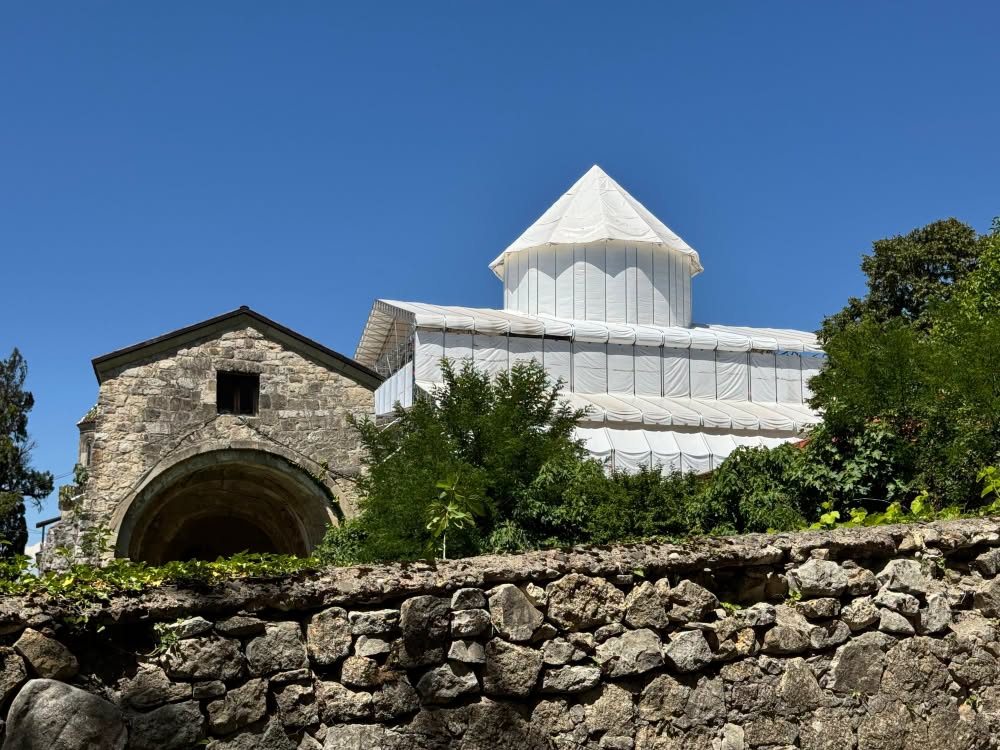
The committee addressed criticism over the temporary roofing installed above the Cathedral of the Nativity of the Virgin. It said the protective structure had been one of the key requirements of the UNESCO World Heritage Centre since 2020 and that the material used was a specially manufactured high-technology PVC fabric produced in Germany and designed to meet international conservation standards.
It also rejected reports of widespread deterioration or falling frescoes inside the cathedral, saying critical areas of the wall paintings had been stabilised and were undergoing phased conservation.
The statement further responded to concerns over the monastery’s historic drainage system. According to the committee, archaeological evidence indicates that drainage channels dating back to the reign of King David IV ceased functioning after the monastery was burned by Ottoman forces in 1510 and had remained filled with soil, ash and charcoal for centuries.
The committee also defended a study of the cathedral’s microclimate prepared by Italian professor Dario Camuffo. It said the report identified condensation caused by temperature differences between the cathedral’s thick stone walls and warmer spring air as one of the factors affecting the building.
One possible solution discussed in the report — gradually warming the floor during the spring and early summer — remains only a preliminary hypothesis and would require further study, the committee said.
The statement also addressed criticism of a memorandum with Italy’s Opificio delle Pietre Dure, one of Europe’s leading conservation institutes. It said the planned “pilot restoration” of wall paintings refers to the standard practice of testing conservation materials and techniques on a small area before broader restoration work begins.
The committee also cited previous assessments of Gelati’s mosaic, including documentation dating back to 1989, to argue that serious structural problems had existed for decades and had not emerged as a result of the current rehabilitation programme.
Concluding its statement, the committee called on critics to avoid what it described as attempts to damage the reputation of the conservation programme and mislead the public.
It said the work currently under way at Gelati complies with what it described as the highest international standards for cultural heritage conservation.
Tags:
Gelati