Gia Baramidze apologises over controversial wording, denies making remarks attributed to him

Author
Frontnews Georgia
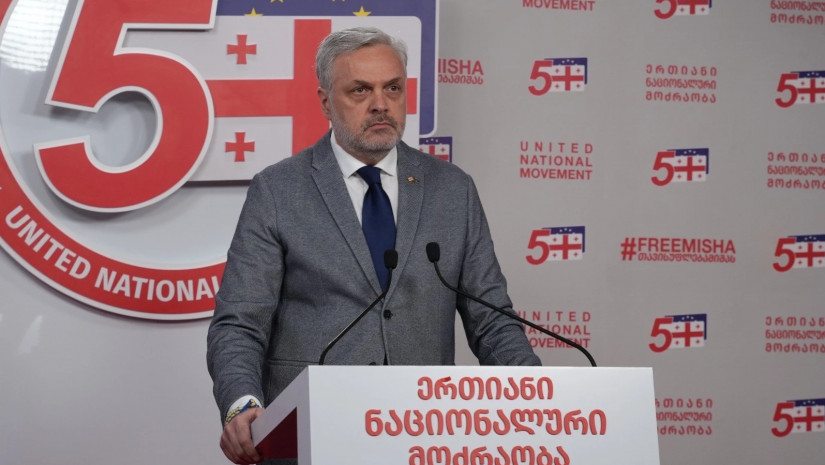
Georgian opposition politician and former interior and defence minister Gia Baramidze has apologised to those who were offended by controversial wording in a recent interview, while insisting that his comments had been distorted and did not carry the meaning attributed to them by his critics and prosecutors.
Baramidze, a senior member of the opposition United National Movement, made the remarks during a court hearing after being charged with treason in the form of sabotage. Tbilisi City Court later ordered him to remain in pretrial detention for two months.
“I apologise to those who became victims of this propaganda, those who fell for Russian propaganda, those who did not watch my interview and were emotionally affected by what they heard,” Baramidze told the court.
He acknowledged that his use of the Georgian word corresponding to “shooting” or “executing” had been inappropriate and could have created a misleading impression.
“The word I used creates a certain association and I should not have said it. I should have been more careful, and I accept that criticism,” Baramidze said.
“But I absolutely did not express the meaning they are now trying to attribute to me.”
Baramidze said the broader context of his remarks made clear that he had been referring to combat during the war in Abkhazia rather than the execution of prisoners.
“I said from the beginning that we did not have prisoners. If there were no prisoners, no one could have been lined up against a wall and executed in that sense. Our people were fighting in battle,” he said.
Baramidze said he found it uncomfortable that he had to publicly defend himself against accusations of betraying the country.
“I feel uncomfortable even having to say that I am not a traitor to my homeland,” he said.
He accused prosecutors of pursuing what he described as a politically motivated and “dirty” case and claimed that the authorities were acting on instructions from Georgian Dream founder Bidzina Ivanishvili.
Baramidze repeatedly referred to Ivanishvili as a “Russian oligarch” and alleged that the prosecution was serving Russian interests, claims neither Ivanishvili nor the Georgian authorities accept.
Baramidze said that while he had fought against Russian forces during the war in Abkhazia, Ivanishvili had been making money in Russia.
“This is revenge against Georgia and against me personally,” he claimed, alleging that Ivanishvili was seeking to subordinate Georgia to Russia.
He also accused prosecutors of applying double standards, arguing that they had failed to respond to statements by government figures that, in his view, damaged Georgia’s national interests and international reputation.
Baramidze referred in particular to political statements concerning responsibility for the 2008 Russia-Georgia war and calls for an apology over past conflicts.
“Why did no one in the Prosecutor’s Office feel the need to react when this regime accused the country of starting the war?” Baramidze asked.
He also rejected the prosecution’s argument that he should remain in detention because of possible procedural risks.
“I was not going anywhere,” he said. “For the past month there has been a campaign against me, this Russian propaganda. If I wanted to leave, could I not have crossed into Türkiye or gone somewhere else?”
Baramidze argued that he had no realistic means of influencing witnesses or evidence because the case concerned an interview that had already been recorded and made public.
“What influence could I possibly exert? We are talking about an interview that has already taken place. No one can change that fact,” he said.
He added that he had no intention of fleeing the country and described his detention as unnecessary.
“My imprisonment serves absolutely no one except the Kremlin, Putin and the Russian oligarch who serves Putin,” Baramidze said.
Tbilisi City Court ordered Baramidze to remain in pretrial detention for two months.
Georgia’s Prosecutor’s Office detained him on September 11 under a court order and charged him with treason in the form of sabotage. The charge carries a maximum sentence of four years in prison.
Tags:
Gia Baramidze