EU Ambassador Accuses Georgian Government of Ignoring Brussels and Launching ‘Unprecedented Attacks’ on EU Institutions

Author
Frontnews Georgia
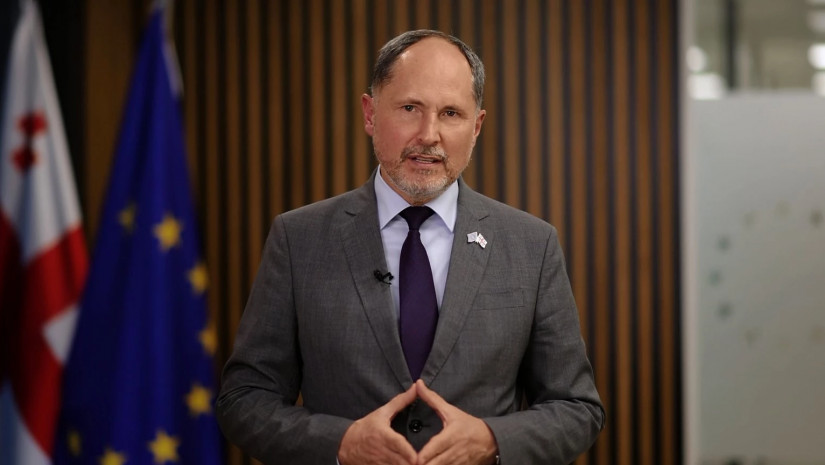
The European Union’s Ambassador to Georgia, Paweł Herczyński, has accused the Georgian government of ignoring repeated warnings from Brussels and escalating its anti-European rhetoric, warning that the country’s EU accession prospects have deteriorated further over the past year.
Speaking to journalists, Herczyński said that any country seeking EU membership, including Georgia, must progressively align itself with the bloc’s principles, standards and values.
“Unfortunately, what European Commissioner for Enlargement Marta Kos said is disappointing and personally causes me great sadness. However, it is the result of the current government’s consistent actions, legislation and anti-European rhetoric. Unfortunately, these actions have consequences,” Herczyński said.
The ambassador noted that the European Commission is expected to publish its next enlargement report in three weeks, providing an updated assessment of Georgia’s progress towards EU membership.
“In three weeks, the European Commission will publish its next enlargement report, and I will hold another press conference. In Brussels, the High Representative/Vice-President and the Commissioner responsible for Enlargement will also hold a press conference. We will see what message they deliver,” he said.
Herczyński recalled that the previous enlargement report, published last November, had delivered what he described as a devastating assessment of Georgia’s European integration process.
“Unfortunately, last November’s enlargement report was devastating for Georgia. The situation has not improved over the past year. On the contrary, it has deteriorated further in terms of fundamental freedoms and what we call the fundamentals,” he said.
The ambassador said the European Commission’s upcoming assessment would provide further clarity on Georgia’s position in the enlargement process.
“We will see what the European Commission’s assessment will be in three weeks. Of course, I will be happy to share it with you at a special press conference. You are already invited. The event will most likely take place on October 28,” he added.
‘Georgian authorities are not listening to the European Union’
Herczyński expressed particular concern over what he described as an unprecedented wave of attacks against the European Union, its institutions, the European Parliament and senior EU officials.
“Unfortunately, the authorities are not listening to the European Union’s messages,” he said.
The ambassador recalled that the EU Council had first formally called on Georgia to reverse its political course in June 2024, with all member states agreeing on the steps required to restore progress towards European integration.
“Let me remind you that the first Council conclusions calling on Georgia to change its course were issued in June 2024. For two and a half years, we have been urging the Georgian authorities to change their course of action assuming, of course, that they are genuinely interested in joining the European Union,” Herczyński said.
He pointed to subsequent EU statements issued in October and December, as well as the Council presidency’s conclusions on enlargement adopted last December, specifically paragraph 138, which he said outlined the steps Georgia needed to take to return to its European integration path.
“You can read for yourselves what steps the Georgian authorities need to take to get back on the path of European integration. All our appeals have been ignored,” he said.
“On the contrary, as I have read again in recent days, there have been unprecedented attacks on the European Union, its institutions, the European Parliament and EU institutional leaders. This is deeply regrettable and disappointing, but unfortunately, this is the reality we face today.”
EU sanctions against Georgian officials remain under discussion
Asked whether Georgia should expect sanctions, Herczyński said the EU had not reached the unanimity required to impose restrictive measures against specific individuals in the country.
“I cannot give you a specific answer. As far as the European Union’s sanctions policy is concerned, the standards are very high. Decisions on sanctions must be taken unanimously,” he said.
“What does that mean? It means that all EU member states must agree.”
The ambassador confirmed that potential sanctions targeting specific individuals in Georgia had been under discussion for approximately two years, but member states had yet to reach a consensus.
“The issue of sanctions against specific individuals in Georgia has been under discussion for two years. However, at this stage, there is no unanimity,” Herczyński said.
Tags:
Paweł Herczyński