Middle East, Iran currently greater priority for US than ending Russia-Ukraine war, analyst Jejelava

Author
Frontnews Georgia
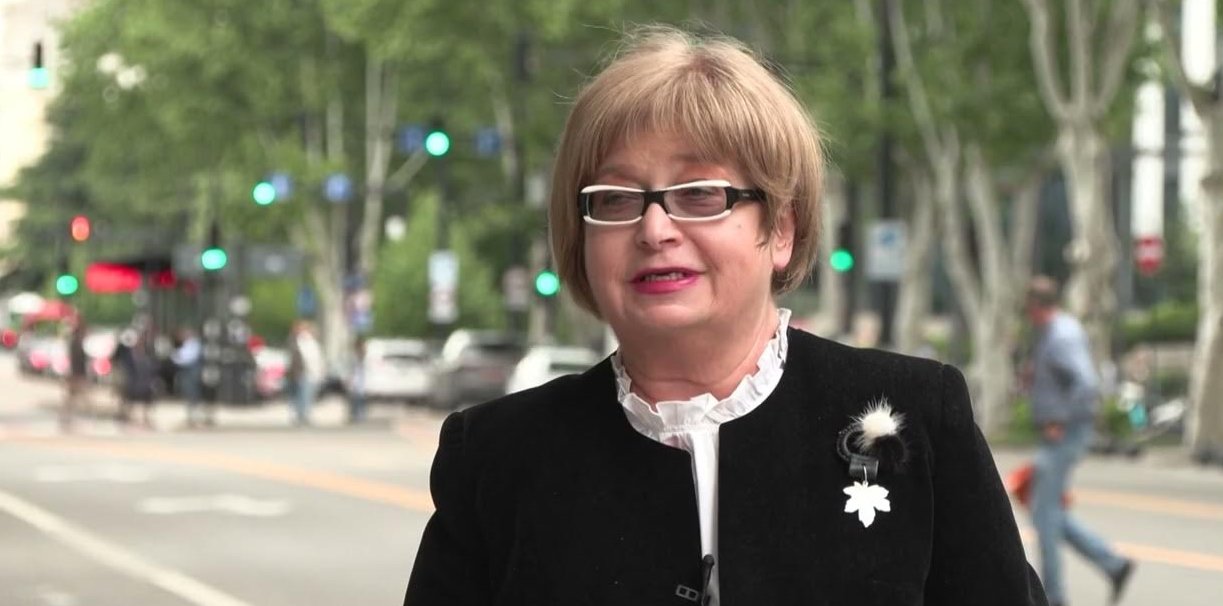
International affairs analyst Lela Jejelava, in an interview with Front News, assesses high-level contacts between Washington and Moscow, the strategic dynamics of the war in Ukraine, and ongoing domestic political developments in Georgia.
Jejelava said the visit to Moscow by US Central Intelligence Agency Director John Ratcliffe is more closely linked to efforts to neutralize Iran’s position in the Middle East and to deliver preventive messages than to any “strategic deal” over Ukraine.
Jejelava also discusses Ukraine’s asymmetric strikes against Russia’s energy infrastructure and domestic criticism within Ukraine, while interpreting developments within Georgia’s ruling establishment as part of a struggle to retain political power.
Q: US Central Intelligence Agency Director John Ratcliffe’s visit to Moscow was described by Donald Trump as “semi-routine,” with the US president saying that “something might come out of this meeting.” The Kremlin, meanwhile, has said it is still too early to speak of overcoming the crisis in bilateral relations. In your assessment, what messages are actually being exchanged between Washington and Moscow, and is there any basis for the process developing into a strategic deal behind Ukraine’s back?
Lela Jejelava: The idea of exchanging one thing for another is a very stereotypical notion that we have inherited from the geopolitical realities of the last century. If we look closely, we will understand that we are facing a completely different reality today.
Everyone - particularly the major political actors - has clearly defined interests, and accordingly, nobody is simply going to trade one thing for another. To be honest, I cannot tell you why anyone has decided that Ukraine should be traded for something else.
At this point, I believe this meeting is probably connected more to the Middle East than to Ukraine. That said, it is a fact that Ukraine would also have been discussed.
For the United States, it is important to neutralize Russia in the Middle East as an ally of Iran. The person best positioned to do this was the CIA director, who has access to precise, objective and operational intelligence regarding the type of assistance Russia is providing to Iran.
Naturally, this would have been discussed. The meeting would also have been an opportunity to convey messages that the United States has other capabilities available to it for preventive action.
So far, there is no information about what exactly was agreed. Developments over the coming period - approximately the next month - will give us a better understanding of what may have been discussed and agreed at this meeting.
At this point, the Middle East and Iran are a greater priority for the United States than ending the Russia-Ukraine war.
Q: Ukraine’s strikes on Russia’s energy infrastructure and the economic cost of the war are becoming increasingly significant. Ukrainian drones knocked out Lukoil-Nizhegorodnefteproekt, Russia’s fourth-largest oil refinery, leaving virtually all of Lukoil’s major refineries out of operation. How effective is this asymmetric strategy in weakening Russia’s military machine financially and logistically, and can it force Moscow to adjust its war plans?
Lela Jejelava: Politically, what I see at the moment is that the Ukrainians are calculating that they need to create such a level of discomfort inside Russia that they weaken its war machine as much as possible.
If we look at what are considered strategic targets, these include major hubs of medium-sized businesses - such as Wildberries and Ozon warehouses - as well as oil-refining infrastructure.
Naturally, all of this causes damage to Russia. It suffers economically, while its military machine is also facing particularly serious problems as a result.
At the same time, as we can see, public dissatisfaction inside Russia is growing. If mass mobilization is added to this at the end of September, after the elections - and Putin has not ruled it out - public dissatisfaction inside the country will inevitably increase.
This is particularly significant given that leaving the country will also become more difficult for people.
As for mobilization, if it is announced, it will affect major cities such as Moscow, St. Petersburg and Yekaterinburg, where public opinion has a greater influence on political processes than it does in the regions.
Therefore, from this perspective, I believe the Ukrainian approach is correct. However, there are questions as to whether this is sufficient to bring Russia’s military machine to a standstill, and there is a sense that it may not be enough.
Russia still has sufficient resources to continue bombarding Ukrainian cities with ballistic missiles.
The Ukrainians are clearly trying to disable, before winter, the infrastructure that is important for Russia’s electricity supply. That is understandable. However, Russia still has the capability to continue doing this.
Therefore, Ukraine needs a breakthrough in order to defeat the Russian war machine. At the very least, it needs to do more to disable Russia’s air-defense systems.
Q: At the same time, former Ukrainian Defense Minister Mykhailo Fedorov has said that Ukraine is gradually losing the war and lacks a coherent vision for victory, prompting an indirect response from the presidential administration. How alarming is this internal disagreement at this stage of the war, and how does it affect the attitudes of Ukraine’s Western partners?
Lela Jejelava: The West has its own strategy regarding Ukraine, and there are differences between the European and American approaches. These strategies do not change according to the sentiments of individual officials within the Ukrainian government.
The point is that when people are in government, they tend not to remember that “Ukraine is losing.” Fedorov is not the only example. Oleksiy Arestovych is no less intelligent, and while he was part of the government, he made every effort to participate in information and propaganda efforts that had a major influence on Ukraine’s ability to put up strong resistance to Russia.
But as soon as he left the government, he immediately began talking about Ukraine losing the war.
A considerable amount of time has passed since then, and Ukraine continues to put up strong resistance to Russia.
Fedorov was defense minister just two months ago, and at that time he was not saying that Ukraine was losing.
Whether Ukraine wins or loses does not depend on one individual. First and foremost, it depends on the will of the Ukrainian people.
Yes, Fedorov is right that there is corruption in Ukraine. However, Ukraine was under post-Soviet influence, and Russian influence still remains in the country.
Fedorov also forgets that the country fighting Ukraine has considerably greater levels of corruption.
This is part of an internal political struggle, and there is nothing surprising about it.
Fedorov is a young and talented person with his own political ambitions, and all of this is largely part of the domestic political arena.
Naturally, the Russian media will seize upon these statements. Western media already pays considerable attention to issues and alleged schemes inside Ukraine as well.
Despite all of this, Ukraine has been fighting for five years against an army that is considerably stronger than its own, while it has managed to push the war back to where it began. That is a fact that neither Fedorov nor Arestovych can change.
It is in the West’s interest that Ukraine should not lose. We have already seen this over the past five years.
Q: In recent days, new serious allegations have emerged surrounding former Prime Minister Irakli Garibashvili, including claims of possible corruption schemes within the Ministry of Defense and alleged episodes involving the “plundering of the army.” How do you assess these domestic political developments? To what extent do they damage the country’s defense capabilities and the reputation of its institutions, and what political consequences could such high-profile accusations have within the ruling team? What kind of dynamics are currently unfolding within the government’s power structure?
Lela Jejelava: [Ruling Georgian Dream founder and honorary chair] Bidzina Ivanishvili is fighting to retain power, and that is his sole objective. This includes both financial and political power.
As for which puppet he will remove and when, or which one he will take out of the box, that is not of fundamental importance.
We know very well that this man is in a dead end. Most likely, he will now also have to replace Kobakhidze, because Ivanishvili has sent his main support away with a “wolf ticket.”
When someone says, “I am leaving politics,” that means he has been sent away with such a ticket.
Kobakhidze will probably face the same fate.
What difference does it make which puppet - used or unused - he takes out of the box now?
Our task is to take power away from Ivanishvili. Who leaves, who arrives, and when they do so is not of fundamental importance.
By Elza Paposhvili
Tags:
Lela Jejelava